




| Nominal Diameter (DN) | Outer Diameter (mm) | Wall Thickness (Taking K9 as an example) (mm) | Common Length (m) | Weight per Meter (Taking K9 as an example) (kg) |
|---|---|---|---|---|
| 80 | 98 | 6.0 | 6, 8, 9, 12 | 12.87 |
| 100 | 118 | 6.0 | 6, 8, 9, 12 | 15.89 |
| 150 | 170 | 7.0 | 6, 8, 9, 12 | 24 |
| 200 | 222 | 8.0 | 6, 8, 9, 12 | 32.3 |
| 250 | 274 | 9.0 | 6, 8, 9, 12 | 42.4 |
| 300 | 326 | 9.0 | 6, 8, 9, 12 | 53.8 |
| 400 | 429 | 10.0 | 6, 8, 9, 12 | 80.3 |
| 500 | 532 | 11.0 | 6, 8, 9, 12 | 111.5 |
| 600 | 635 | 12.0 | 6, 8, 9, 12 | 147 |
| 800 | 842 | 14.0 | 6, 8, 9, 12 | 232.3 |
| 1000 | 1048 | 13.5 | 6, 8, 9, 12 | 336.2 |
Characteristics:
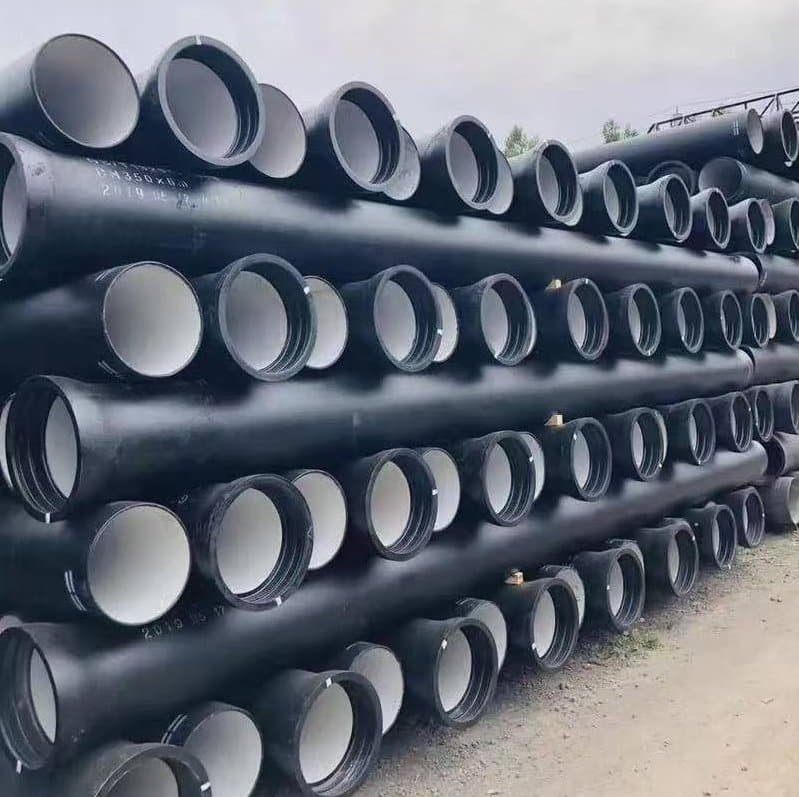
Excellent Mechanical Properties: The ductile iron pipe has relatively high mechanical properties such as tensile strength, yield strength and toughness. Its tensile strength can reach above 420MPa, which is greatly improved compared with that of ordinary gray cast iron pipes. This enables it to withstand relatively high pressure and can be used in medium and high-pressure water supply, gas supply and other pipeline systems.
Good Corrosion Resistance: A dense protective film can be formed on the surface of the ductile iron pipe, which can effectively resist chemical corrosion in media such as soil and water. In the underground buried water supply pipelines, its service life is relatively long, generally reaching 50 – 70 years or even longer, much longer than that of ordinary steel pipes in the same environment.
Convenient Installation: The ductile iron pipe has various joint forms, such as socket and spigot joints, flange joints and so on. The socket and spigot joints are sealed with rubber sealing rings. During installation, it is only necessary to insert the pipe into the pipe fitting and utilize the elasticity of the rubber ring to achieve sealing. The operation is simple and fast, and the sealing effect is good, which can effectively prevent leakage.